.png)

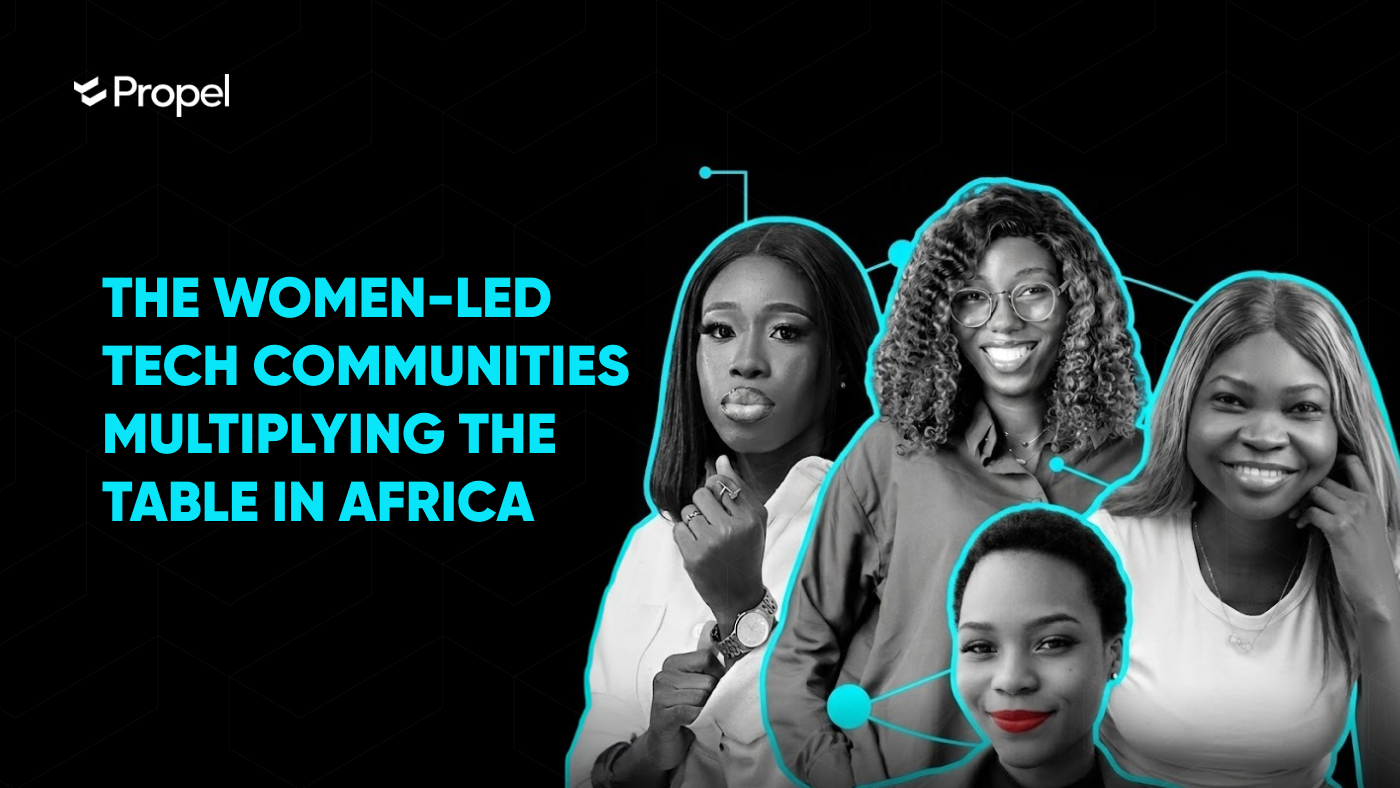
For years, the language around inclusion has been familiar. Women need access. Women need representation. Women need a seat at the table. But across Propel's network, a different reality is taking shape. Women are already designing the pathways, defining the standards, and expanding what the table even looks like.
.jpg)
The Gap Before the Growth
Every one of these communities began with the same recognition: a lack of structure.
In Malawi, Innocencia Ndembera saw it clearly. "Women in Tech Malawi was created to address a gap I repeatedly observed in the local tech ecosystem. While many women were interested in technology, very few had access to the networks, mentorship, and learning opportunities needed to grow sustainable careers in the field." What began as a small initiative has gradually evolved into a platform focused on clearer growth and leadership pathways for women in tech.
A similar pattern shaped Trail Alley. For its founder, Duty Osamudiamen, the starting point was personal. "When I started my journey in tech, access was a major challenge for me as a beginner. Access to learning materials, mentorship, opportunities, and supportive communities." Realising that little had changed for those coming after her sparked the need to build a community especially for women looking to build sustainable digital careers.
She Innovate entered the ecosystem from yet another angle: progression. Adetoun Raji-Kolade, Programs Manager at She Innovate explains that the community was built “with a clear mission to empower women by providing the resources, mentorship, and community needed to transition from technical roles into leadership positions”, ensuring that representation extends into decision-making spaces.
Taken together, these origin stories form a clear pattern. Each community is a response to specific, recurring gaps. And instead of waiting for them to close, these women built around it.
What Actually Holds Women Back
The barriers women face in tech are often reduced to a single narrative. In reality, they are layered, structural, and persistent.
One of the most common challenges is not learning, but transition. "Many women struggle to understand how to transition from learning into actual industry roles," Innocencia notes. This gap between skill acquisition and employment is where many journeys stall.
Then there is mentorship or the absence of it. "Tech ecosystems tend to be heavily relationship-driven, and many women do not have access to experienced professionals who can guide them or connect them to opportunities."
Adetoun points to a more specific bottleneck. "Two of the most significant hurdles are the lack of entry-level internships and the scarcity of high-quality job opportunities. Without these critical first steps, it becomes incredibly difficult to bridge the gap between learning a skill and building a sustainable career”.
Beyond access and opportunity lies something harder to quantify: belief. Faith Ayoola Oni, who leads GDG Ado-Ekiti, She Code Africa Ado-Ekiti, and Women Techmakers, saw this up close. "A lot of women don't think that they are capable or that they are good enough to pick up skills and do amazing stuff." She draws a powerful comparison: "Women are very audacious when it comes to other aspects of their lives — their children, their homes. But when it comes to learning tech skills, they feel like it's not for them because it's more male-dominated."
Cultural resistance compounds this further. Faith shares a story that captures the challenge vividly: "There's a woman I know who's married with two kids. She was working in a tech organisation. Each time there was discussion around her need to be promoted or a gig that brought extra funds, there was always tension. Some men are still not comfortable knowing that women can come to the field of tech, earn more, and even surpass them."
Resource constraints make everything harder still. "A lot of women want to learn but they don't have laptops, they don't have money for data, they don't have good electricity," Faith adds.
These are daily realities, and these communities understand that if you only solve for skills, you leave the system intact. If you solve for structure, outcomes begin to change.

Building Where Gaps Exist
These women didn't wait for someone to fix the system. They built new ones and with intention.
Learning that leads somewhere. Women in Tech Malawi created structured environments where women understand how acquired skills translate into careers. Trail Alley focuses on sustainable pathways, and under Faith's leadership, GDG Ado-Ekiti takes a deeply personal approach: guiding women through figuring out their career paths and creating spaces where they feel "more heard, more seen, and more attended to, so they are able to embrace tech more."
Mentorship that actually works. These communities embed mentorship into their DNA as a foundation. Members who joined with zero knowledge now mentor others. Women who once struggled to understand what they wanted to do now guide newcomers through the same confusion. "While volunteering for Google events, I was able to guide people on what to do, what not to do, help them understand what they want, what they had passion for," Faith explains.
Opportunities that connect to real work. Teaching skills is necessary but not sufficient. She Innovate positioned their women for "high-level job opportunities, effectively bridging the gap between talent and employment." The emphasis across all three communities is on closing the distance between learning and earning.
Confidence that comes from community. "Community to me is where I can find like-minded people, where I am open, I feel valued, I feel like I belong, and I can both give and receive things that can help me build my career," says Faith. Duty echoes this: "Community means having people who support your growth and remind you that you don't have to navigate your tech journey alone." The confidence that comes from seeing someone like you succeed, and from realising you're not alone in the struggle is a prerequisite for everything else.

When Learners Become Leaders
The clearest measure of impact is not how many people join a community. It is what they become after they do. Across these ecosystems, a pattern keeps repeating. Women enter as learners. They stay long enough to become contributors. Then, without ceremony, they become leaders.
"One moment that stands out was seeing members move from being learners to becoming leaders within the ecosystem," Innocencia says. She describes women who once doubted their abilities now leading projects, mentoring others, and speaking publicly about technology. “Seeing that shift has been incredibly meaningful.”
Trail Alley has watched similar transitions unfold. "One of the most rewarding moments has been seeing members start with little or no tech knowledge to eventually secure job opportunities, launching personal projects, or supporting others in the community," says Duty.
She Innovate captures this proud moment evolution in a different way. Specialisation. One of “our proudest moments is witnessing a significant surge of women within our community successfully specializing in high-demand niches. Seeing them transition from general learning to becoming experts in their specific fields was a major turning point.”
Faith describes the compounding impact with unmistakable pride. "We've seen so many of our women members doing amazingly well in their careers. They started off with zero knowledge. But now, two, three, five, ten years down the line, we are seeing amazing women thriving, taking speaking gigs, and paying it forward." She knows members who've worked at Microsoft and Google. But what moves her most is knowing they are not just succeeding, but also helping other women succeed too.
What begins as learning does not end there. It multiplies. And that moment a community can vouch for its members, marks a turning point that indicates that the ecosystem is no longer just supportive, but also credible.
Propel as an Ecosystem Support
No ecosystem grows in isolation, and the strength of these women-led communities is amplified by the networks they are part of. With Propel, the role is not to swoop in and save. It is to enable and amplify what these communities are already building.
For Women in Tech Malawi, this has meant increased visibility and access to a broader network of collaborators. "Through Propel, we've been able to connect with other community leaders, share
experiences, and learn new approaches to building sustainable tech communities." It has also influenced how they think about structure. “Their support has helped us think more strategically about how we design programs, engage members, and create opportunities.”
Trail Alley’s experience reflects a more direct pipeline to opportunity. "Through the Propel platform, our members gain access to curated job opportunities and career resources that support their professional growth." For She Innovate, visibility has been the defining shift: "Working with Propel has been a game-changer for our visibility. They have significantly amplified our voice within the global ecosystem."
Faith remembers the early support vividly. "In the early years when we were onboarded on the Propel platform, we had a DevFest event where we were supported physically and with funding. There was so much value we got from that partnership."
This kind of support extends community work and connects local momentum to a broader, more powerful network.

Redefining What Community Means
At the heart of each of these ecosystems is a shared belief about community as an infrastructure
Innocencia puts it plainly: "Community is the foundation that turns individual ambition into collective progress." Duty frames it in human terms as "having people who support your growth and remind you that you don't have to navigate your tech journey alone."
Adetoun pushes it further into the language of systems and power. "Community is the vouching currency and collective support system that transforms isolated effort into institutional leadership."
It provides mentorship, opens doors, and creates visibility. Members vouch for one another, recommend each other, and build trust that extends far beyond the community itself.
This is also where the metaphor of the table begins to fall apart.
Because what these women are building is an entirely new structure where opportunity is shared, growth is collective, and leadership is an outcome.
Beyond the Table
The metaphor of getting a seat at the table has always carried a quiet flaw. It assumes the table already exists, that the right structure is in place, and that all women need is access to spaces men have already built.
These community leaders understand something deeper: the existing tables weren't designed for them. The pathways weren't built with their realities in mind. So they built new ones.
It is easy to measure progress by numbers; more women hired, more women promoted. But the deeper shift is harder to quantify.
It is in the woman who enters a community unsure of her path and leaves with both a skill and a network. It is in the member who becomes a mentor. It is in the quiet moment when a community can recommend its own talent with confidence.
These are not isolated wins. They are signs of a system being rebuilt in real time.
International Women’s Month offers a moment to reflect. But what these communities show is that the real work happens outside the spotlight.
They are not waiting to be included.
They are building something better.
.png)
.png)

.jpg)
.jpg)



.jpg)

.jpg)


